
Selling electricity back to the grid
Electric cars will sell electricity back to the grid in the future, making them even more cost-effective for owners

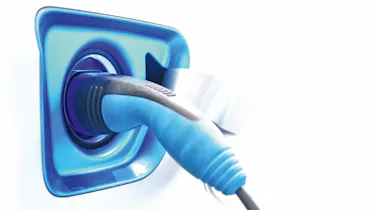
Very soon it should be possible for owners of electric cars to actually make money from their EVs, but how is that possible? Electric car batteries can be treated as mini power storage facilities, and send electricity back to the National Grid when needed to balance out the overall load. This makes use of something called 'vehicle-to-grid' (V2G) technology, which is still a bit of a niche area right now, but stands to become mainstream in the not-too-distant future.
Sounds interesting, right? Unfortunately, this isn't yet something all electric car owners can instantly sign up for. As of May 2024, Octopus Energy is the only energy provider in the UK to have launched a vehicle-to-grid (V2G) tariff. Octopus has stated that a V2G driver could save £880 per year compared to regular customers. The company will set up your charger to automatically manage your charging and discharging, allowing you to fill up for free.
However, there are a few caveats. You need to have the Wallbox Quasar 1 wallbox installed, which is no longer available for sale in the UK. Additionally, only three vehicles are currently compatible: the latest Nissan Leaf, Nissan e-NV200, and Mitsubishi Outlander PHEV. Although the company states that they are working on further integrations.
Beyond that, some other providers have run trial schemes with private and business customers. So for most customers a V2G charging service isn't generally available, but this is a sign that owning an electric car will become a lot more beneficial in the near future. Manufacturers will need to work on more compatible EVs and hardware before this becomes a viable option for most consumers.
What is vehicle-to-grid (V2G) charging?
It’s possible to feed the energy stored in your electric car’s battery back to the National Grid. This will help supply homes with power during the hours when demand is at its peak – often the evening and the early hours of the morning.
A nationwide V2G system will be possible when the vast majority of electric cars come with V2G technology. Besides the models mentioned previously, more models will be coming soon with this technology, from brands such as Nissan, Kia and Hyundai. With the majority of current EVs, however, it's a one-way system where the charger draws power from the grid into the battery, and can't send it back.
With a V2G-compatible car and charger, electricity held in the battery can be discharged back to the grid. As the owner, you get paid for that energy. Of course, you'll have paid to draw it in the first place, but if you've charged at off-peak times when tariffs are lower and are sending power back to the grid at peak times when they're higher, you can pocket the difference as profit.
Can I sell electricity back to the grid now?
If you've installed solar panels, wind turbines or other means of independent power generation on your property, then it is currently possible to sell energy back to the grid. But unless you're participating in a government-backed trial or lucky enough to meet the Octopus criteria, it's not yet possible to do the same using your electric car.
In April 2010, the UK launched feed-in tariffs (FITs) – rates at which those generating their own power can sell it back to the grid. These rates periodically changed since the scheme was launched, decreasing in value each year until the scheme was ended back in 2019.
It was then replaced in 2020 with a new scheme called the Smart Export Guarantee (SEG). This new scheme is an updated version of the FITs scheme, allowing you to feed back into the grid any residual renewable energy from your home or business that you won’t use and get paid for it. To check if you are eligible for this scheme or to apply, you can visit the government ofgem website for all the details you need.
